
Applicants are required to submit ‘Supplementary information’ to support their application. This should be submitted at the same time as the application and must be received within the same deadlines. We appreciate that some details may not be confirmed until closer to the time of the Event, but a comprehensive management plan is usually sufficient.
The requirement for supplementary information is described via the application process; there will be an option to input information and/or submit or upload documents. For most medium/large or repeat events, information should be submitted in the form of an Event Management Plan (EMP). An EMP can be updated and re-submitted for repeat events, or as plans develop. If you revise your supporting documents and want to send updated versions (post application), you must add a version reference and highlight or track changes.
The level of supplementary information required will be dependent on the nature, content, and scale of the Event. Further information may be requested on any aspect of the Event at any stage, but in general the level of information required is relative to risk level i.e., an additional requirement may be set where an elevated risk is identified.
The Events Service will provide you with a checklist to communicate the status of your application; this will identify any issues or where further information is required. You may be directed to guidance to make the required improvements; some Guidance Links are provided at the end of this document. The Purple Guide is taken as the primary ‘industry standard’ guidance source for outdoor events. Approval will be granted when your event documentation has been checked in line with the Council’s requirements.
A site visit should be the first step in assessing site-suitability to inform your event layout and to identify any potential hazards or site-specific considerations. Comprehensive maps/plans must be provided for events taking place on Council managed land. They must include all areas of land that are used or significantly impacted by the Event, for example, the Event may take place in a park, with a car park in a neighbouring area and traffic restrictions in the surrounding roads, all of which should be included. A route map must be supplied for events which follow a route e.g., a procession or running/walking/cycling event, but additionally a site map must be considered for the start and end points.
It is useful if your plans give an indication of scale (scaled drawings are not usually required). Unfortunately, we are unable to supply base maps, but some web-based maps may be appropriate.
Site map
- Event location
- The event location must be shown within the context of the site and surrounding area.
- Consider all elements of the Event; main site, back of house or parking areas, event-related activity in surrounding area.
- Sites should be clearly named using the correct site name.
- Maps must be sent as a file and not embedded into an email.
- Event layout
- The layout of significant infrastructure and activities must be marked on the site map.
- The infrastructure and activities shown must be consistent with the content that has been declared on the application form.
- Access routes and control points
- Pedestrian and vehicle entrance/exit points and flow routes should be marked (consider how vehicle/pedestrian interaction is minimised).
- Control points should be identified i.e., where people/vehicles have to check-in to gain access.
- Mark any emergency clearways, access or egress routes for use in the event of an emergency.
- Consider any designated RVPs (rendezvous points) for use in the event of an emergency – you may have more than one or different points for the public vs. organising team.
- Consider how these elements are communicated to team/suppliers/visitors.
- Services
- Mark the location of key services/features on your site map e.g., information point, meeting point, medical provision, toilets, water or other services.
- Consider how these elements are communicated to team/suppliers/visitors.
- Licensable activities
- The location of any licensable activities should be clearly defined e.g., with a red line to demark the perimeter of the licensed area(s) where a TEN or premises is applicable (may be required via the associated licence application).
Route map
- Event route
- Must clearly define the route taken and show the wider context where applicable i.e., from entry into, to exit from the borough.
- Sufficiently detailed to show which path you are using (where there are multiple paths), if the road or footways are being used and where any crossings take place.
- Must be sent as an attached file and not embedded into an email.
- Event layout
- Show the location and details of any infrastructure/activities on Council owned/managed land e.g., gazebos, gantries or the locations of water stations, marshalling/medical points.
- Distance markers and timings.
- Include distance markers and expected timings on your route map, especially in busy areas such or where there is potential for conflict with other events/activities/site users.
- Marshalling/security points
- Show the location of designated security or marshalling points.
- Medical
- Mark the locations of any medical points.
- Mark medical access routes (i.e. for vehicle access in the event of an emergency).
- Signage plan
- Show the locations of directional/safety signage.
- The signage plan should include further specifications as required by the Terms and Conditions and to demonstrate that the route is not restricted.
The Applicant is responsible for ensuring the safe delivery of the Event and ensuring the safety and welfare everyone onsite including staff, volunteers, suppliers and attendees. The Event should be compliant with safety legislation to include, but not limited to; the Health and Safety at Work etc. Act 1974 and the Management of Health and Safety at work Regulations 1999. The Applicant must certify that they understand their responsibilities in this respect. The Applicant can also describe roles and responsibilities of principle staff/suppliers who will be operating under their direction (the Applicant will remain responsible for all suppliers). See HSE Guidance on Running Events Safely. Organisers of large or high-risk events may be required to nominate a competent health and safety advisor who is at least IOSH trained in event safety, to be onsite at agreed stages of the event.
- Statement of compliance
- Describe your intent and approach towards safety at the Event in the form of a policy or statement. Offer commitments, regarding your compliance to relevant safety legislation. Consider all aspects of the Event – specialist activities may require compliance to more specific legislation e.g., The Construction (Design and Management) Regulations 2015 (CDM) or Lifting Operations and Lifting Equipment Regulations 1998 (LOLER)
- Offer commitments regarding meeting industry standards e.g., the Purple Guide.
- Define any safe working systems that are implemented at the Event; these can be set out as individual statements and policies for keys working areas such as traffic management policy, working at height policy, security and stewarding policy.
- Roles and responsibilities
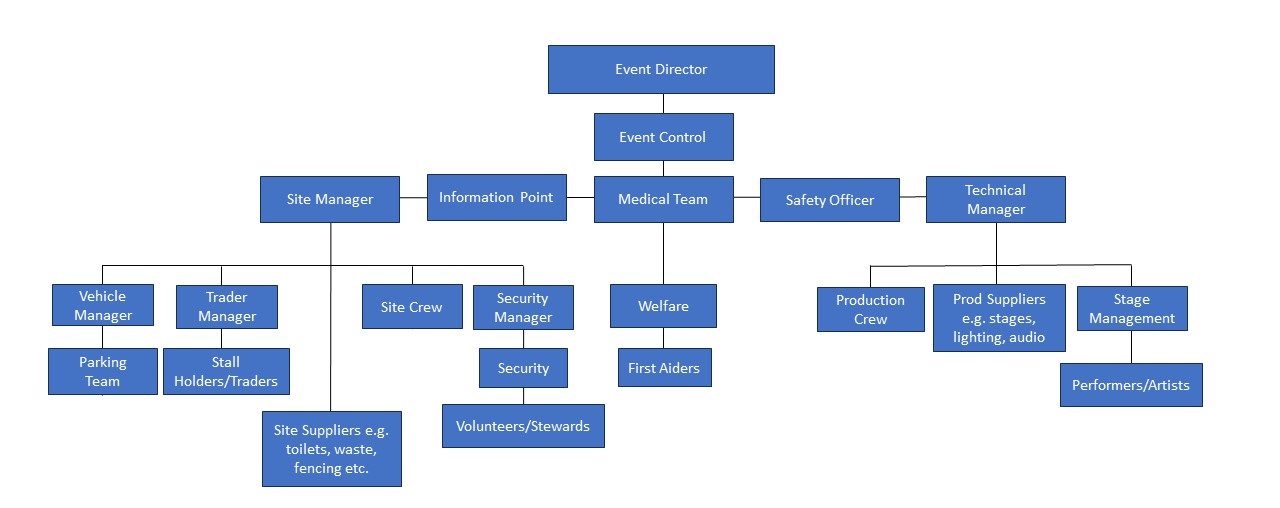
- Where staff/volunteers/suppliers are involved in event delivery, have you clearly defined roles and responsibilities e.g., who manages the traders, who manages the stage area and artists, who manages security provider and stewarding team? Who reports to who?
- Where suppliers or contractors are appointed to deliver specific aspects of the Event, are their roles and responsibilities defined? If you have employed the services an event management company to build the stages and marquees, you should describe their role and clarify points of handover e.g., responsibility is handed back to the Applicant upon completion of the build. If you have appointed a 3rd party Event Safety Advisor, their exact role should be defined in writing e.g., are they checking supplier paperwork in advance for all suppliers, are they carrying out checks on site and if so, which checks, will they be writing a findings report for you post event?
- Where others are given specific responsibilities, are they a competent person to carry out those roles and have you demonstrated their competency (skills, knowledge, experience, training, qualifications)?
- Will you be providing training, briefing materials or onsite meetings for your team pre/during the Event, and follow up with a debrief meeting post Event?
- Have you considered how roles may differ onsite vs. during the event planning stages / have you considered all stages of the Event (build/open/break)?
- Event safety – named person
- Unless it is specifically stated otherwise, the Applicant will be the named person responsible for event safety.
- If another person/company has been appointed all/part of this role, it should be clearly explained in the EMP. You should state the appointed persons competence to carry out the role e.g. NEBOSH certified in event safety.
Applicants are responsible for all suppliers they bring to site. This includes contractors, sub-contractors, infrastructure suppliers, service-based suppliers (e.g., security, medical or event management services), traders, caterers, or performers. Most events have numerous suppliers, it is rare that there would be none. The Applicant should provide a supplier management plan to demonstrate how suppliers are selected, what checks are carried out on them/their documentation and how they are managed.
- Supplier management plan
- Supplier selection – How do you know they are reputable and suitably competent for the role e.g., do you take references, have you inspected their work elsewhere, have you worked with them previously, will you be checking for evidence of qualifications or competencies? Appoint a competent person – HSE
- Roles and responsibilities – Have responsibilities between parties’ been defined and how have you communicated this e.g., via contract or a written agreement?
- Supplier documentation – Define what documents you will be checking and when will you check them. As a minimum you should be checking insurance documentation and site-specific risk assessments. It is the Applicant’s responsibility to check their supplier paperwork and ensure everything is in order, so don’t routinely submit copies of all your supplier paperwork. We may make a specific request for information where required e.g., for spot-checks, large or unusual infrastructure. Provide your assurances regarding the supplier checks you carry out, relevant to the activity/infrastructure being supplied; see ‘supplier type’.
- Supplier communication – How will you communicate the site rules to your suppliers: how will you ensure they are adhering to the Terms and Conditions whilst onsite?
- Supplier management – How will you manage your suppliers? Do you have a production schedule? Do you know when they will be coming and going from site (do you have sign in or check-in procedures)? Who will be onsite to oversee their management? Will you carry out checks on your suppliers/will there be hand over or completion certificates? The Applicant or their nominated representative must be always present to oversee any suppliers who are operating at the site.
- Supplier type – Consider all 3rd party supplier suppliers, with a particular focus on those carrying out high-risk tasks. Suppliers can be considered in categories where appropriate e.g.
- Infrastructure/Temporary Demountable Structures (TDS) e.g., marquees, gazebos, stages. There may be additional requirements such as a site-specific method statement, technical specifications and weight loadings, wind loadings and adverse weather plan, Construction Design and Management Plan (CDM), requirement to sign a completion certificate or handover document. See Temporary demountable structures (TDS)
- Specialist structures and equipment e.g., funfairs/rides, inflatables, cinema screens, machinery/plant. See A-Z below e.g., ‘Funfairs and Circuses’.
- Electrical installations and utilities See A-Z below e.g., ‘Electrical installations’.
- Traders (food/non-food), bars and concessions e.g. for food traders, the Applicant is responsible for checking that traders (food sold or given) are registered with their local authority and hold all relevant compliance documentation such as trading licences, hygiene certification, waste management certification, health and safety record keeping, and gas safe or electrical compliance certification. Consider practical elements like location of water source and cleaning/hand-washing facilities. You may find it useful to cross reference with local authority trader registration requirements e.g. or see national guidance CIEH National Guidance for Outdoor and Mobile Catering. You can Search for ratings | Food Hygiene Ratings and should include the following information:
- Business trading name
- Registered address and local authority (where registered)
- Food hygiene rating inspection score and date (there may be a minimum requirement)
- Service providers e.g., medical, security, traffic, waste, event management services.
- Content providers such as performers or activity providers.
- Specialist providers e.g., fireworks, special effects, pyrotechnics, animals. See A-Z below e.g., ‘Animals’ or ‘Fireworks’.
- Supplier list – Provide a list of suppliers where confirmed. We may ask for confirmation of principle suppliers such as Security Company, Medial Company, Infrastructure Supplier, Funfair Provider or Caterers.
Risks associated with pedestrian/vehicle interaction should be considered for all events where vehicles can enter the event site. As far as is reasonably practicable, the risks should be eliminated or minimised, and vehicle access should be restricted and actively managed. Where vehicles are permitted onsite the risks should be considered in your risk assessment. Careful planning is essential, knowing and understanding what vehicles will need access and when, implementing vehicle management policies and plans, ensuring those directing vehicles are trained, and protecting the ground and trees from damage.
- Vehicle management plan – An overview of arrangements to consider all aspects of vehicle management:
- Essential only – Vehicle access should be essential-only and restricted accordingly. Consider the rationale for why vehicles are permitted access e.g., refrigerated vehicle integral to stand, heavy load, medical response.
- Access routes and control points – Include details of access points, vehicle routes and clearways on your site map as applicable. How are the control points managed? How do you ensure that emergency clearways are maintained? How do you manage vehicle/pedestrian interaction – How are members of the public separated from areas where vehicles might be moving (during all event phases including build/break).
- Responsibilities – Who is responsible for managing access and/or directing vehicles? Will there be marshals/banksmen/stewards and who from the organising team will oversee them? Are they trained/competent to carry out the role? Will they be clearly identifiable? Will vehicles be escorted across the site using banksmen? Will there be a pass or registration number system in place? Will unattended/abandoned vehicles be traceable?
- Arrangements for defined groups – e.g., traders. Have they received clear instruction in advance of the Event? Are they permitted to bring a vehicle to the site/how many? Do they need a vehicle pass? Are there time restrictions – Can the vehicle remain on-site or when must it be moved?
- Site rules – What are they and how will they be implemented e.g., speed restriction 5mph, no vehicle movement 1hr prior to event opening and until the site manager gives the go-ahead post closure to the public, indicators used to show direction of travel (in preference to hazard lights).
- Trees – Vehicle movement or parking under the canopy of the trees is NOT permitted to help avoid soil compaction and damage to tree roots. How will you ensure this?
- Specific arrangements – Maximum/overview vehicle numbers should be provided via the application process, but here you can provide specific information or breakdowns for different areas. Consider the various stages of the Event (build/open/break) e.g.
- Times/dates that access is permitted
- Staff schedules for vehicle management
- Accreditation i.e., vehicle ticket/pass systems
- Breakdown of vehicle numbers e.g. by area or type; traders, contractor/staff/visitor parking, exhibition
- Special considerations e.g. heavy or long loads or specialist lifting equipment.
- Parking arrangements – Who is permitted to park, is there a ticket/pass system, how is it managed?
- Vehicle exhibitions – How may vehicles will be exhibited, how are they managed, are there special rules or conditions such as draining of fuel tanks?
- Ground protection – Will you use trackway; when/where? What checks will you carry out leading up to the event date? Do you have wet weather contingency plans? What will you do if it is very muddy underfoot when you arrive at the site? Event organisers may be asked to install temporary track roadways to protect the ground from damage; where this is set as a condition of the agreement, it will be communicated clearly in writing during the pre-approval stages (e.g., if ground conditions are poor, if inclement weather is forecast or where there is a higher risk of ground damage due to the number or type of expected vehicles). What measures will be in place to protect trees from vehicles? No driving or parking under trees is permitted.
If the event is proposed to take place on highways managed land (including roads and pavement) OR if the event is expected to significantly impact highways management, a Traffic Management Plan (TMP) will be required.
Additionally, a separate application to the highways department may be required for permission to use the affected land, for any associated licences and street trading, or where traffic orders, road closures or parking restrictions apply. If you are unsure if a Traffic Order is required for your event, contact the Highways or Network Management Team directly.
- Traffic management plan will be required to include:
- Route and timings e.g. procession or run route.
- Road closures e.g. closure points and barrier locations
- Parking suspensions
- Diversion routes e.g. busses
- Signage plans e.g. advance warning sign details and locations.
- Pedestrian management plans – including marshalling provision, locations and competencies.
- Local impact – consider Impact on surrounding borough including the transport network.
- Road works – remember to check for and consider planned or emergency roadworks.
- Taxi and PHV arrangements.
The type and level of security and stewarding provision required will be dependent on the size and nature of the Event and should be determined by risk assessment. Follow the advice and guidance of regulatory authorities such as The Security Industry Authority (SIA). Your security management plan should provide an overview of your arrangements and you will also need to supply details such as the numbers/type of security/stewarding personnel you will have onsite during the different periods of the Event. You will also need to factor in any ‘special considerations’ as determined by the nature/style of the event, event content, expected audience profile etc.
- Security management plan
- Rational – How did you decide on the levels of security provided? e.g., advice from specialist, risk assessment, past knowledge/experience of the Event?
- Event capacity – How has the capacity (the maximum number of attendees at any one time) been calculated (based on available space), for the whole site and any enclosed areas within it. How will you be managing/monitoring this onsite and how will attendance be verified/counted? Organisers of large-scale events may be required to provide proof of a bona fide attendance count i.e., through a third-party specialist or other suitable means of verification (ticket sales, wristbands etc.).
- Site layout – Does the site layout facilitate suitable access/visitor flow? Consider the location of significant activities/features (e.g., stages, bar), venue capacity, audience profile, access/egress. How would you deal with issues such as overcrowding?
- Access control – Is access controlled and if so how and why? Is it a ticketed event/do you operate pass systems? Will the site be enclosed/fenced? What are the site rules or terms of entry?
- Roles and SIA accredited personnel – Some roles will require accreditation e.g. manned guarding activity or bag searches. What is your rationale for the provision (or lack) of SIA security?
- Training or briefing – Security and stewards should be fully briefed on all aspects of the event including emergency arrangements and crowd control. Consider who is responsible and when will briefings be carried out; how will information be communicated?
- Uniform – Will the security personnel or stewards be easily identifiable i.e., in tabards/high visibility jackets.
- Communications structure – Is there a clear structure and how do people know what it is? Who will the security personnel /stewards report to, how is information fed back to the Applicant? Who will co-ordinate an emergency response? Do you have a security control point onsite?
- Crime and disorder – Understand the risks associated with your event and plan how to deal with them. Contact the local police and involve your security, medical and welfare providers in the event planning and delivery. You can access current information and intelligence from the Police National Events Intelligence Unit (NEIU) database to identify current crime risks and trends at events. You should have a clear ejection policy, and this should be included in your event plan and shared in your event briefing.
- Police notification – You should inform the local police about your Event taking place (Notify Police Events) BUT police presence is not guaranteed (unless you are paying for a specific service), and as such should not be relied on or presented as part of your event security plan.
- Numbers and competencies
- Number and type – Define the types and numbers of security/stewards present. Are they volunteers or paid? Stewards/marshals, SIA registered security personnel?
- All event stages – Have you considered build/open/break periods and overnight? The site should not be left unattended during the Event Period if there is infrastructure onsite.
- High-risk locations – Identify high-risk locations such as bag searches, overnight provision, or areas of potential conflict e.g., bars/sale of alcohol, restricted entry points (including any ticketed areas), cash collections, stage areas? Will you be using SIA registered security in these areas (if not you may be putting untrained persons at risk)? The Security Industry Authority (SIA)
- Schedules – Can you provide copies of security schedules and key locations/control points? Will the security/stewards be at fixed points/areas or roaming etc?
- Programme – Have you provided a programme for your Event including artist details, line-up, timings and running order for any stages or activity areas?
- Access arrangements – Clarify any access restrictions, ticketing details, terms of entry, site rules.
- Cash and collections – Do you have a cash handling policy or carry out cash collections? How do you to minimise risk? Do you carry out charity or street collections and have you sought the required permissions to do this? Charity Collection Licensing / Street collection licences
Event organisers must ensure the safety and welfare of those attending the Event. The Applicant (or nominated representative) should be readily contactable by the attendees and the local community i.e., to report an issue or provide feedback. There should be procedures in place to identify and provide for any vulnerable groups including minors. We will also consider your approach towards inclusivity and accessibility, and how you plan to record and respond to any issues or complaints.
- Information point – It is in the Applicant’s interest to make themselves readily available and provide clear contact details pre/during/post Event. This gives the Applicant the opportunity to be aware of and respond to issues at an early stage, and as such can reduce incidents and complaints.
- How do members of the public contact the event organiser with queries/issues?
- Are you able to provide information on the event layout and available facilities in advance?
- Do you have an information point, organisers office or production office onsite?
- Will the information point or organisers contact point be clearly identifiable onsite, so that attendees know where to go or who to contact?
- Will you be writing a local resident’s letter or publicise organisers contact details locally in advance of the Event? Will it be a formal letter? Is there a copy in your EMP?
- Safeguarding minors and vulnerable persons – You should prepare an event-specific policy or statement which considers any children or vulnerable adults who may be attending your Event. Are your staff trained to the appropriate level (dependant on their role)? You should appoint a designated safeguarding lead and ensure your staff are checked (e.g., DBS) and trained in accordance with current guidance.
- Do any event activities specifically engage minors under the age of 18? Will minors be attending in the absence of their parents/guardians or be left in the care of event representatives (including lost children which is a consideration for all events)? If so, you will need to provide specific details and procedures surrounding those activities. Where attendees include both minors and adults, how will minors be identified?
- Policies/procedures should be in line with current legislation e.g., for child protection; The Children Act 1989/2004, Keeping Children Safe in Education, The London Child Protection Procedures. For further guidance on suitable policies and procedures, Safeguarding minors es and events from and vulnerable persons please read through Safer activities and events from the NSPCC
- Do you have a Designated Safeguarding Lead (DSL), and have you clearly defined their role at the Event e.g., overseeing lost persons’ procedures? Have you considered and defined all roles where there may be involvement with minors (e.g., activities, toileting agreements, medical)?
- Have all staff/suppliers involved undertaken the appropriate training relevant to their role? For example, the DSL at an event should be trained to L3 ‘Child Protection Process Level 3 Training’, all those with a direct involvement with minors should be trained to at least L1. How do you manage and check this?
- When recruiting staff/appointing contractors what checks will you carry out: Do you apply a Safer Recruitment process? Do you conduct DBS checks/enhanced DBS checks, if so, how often (e.g., DBS certificate checks are recommended on a 3-yearly basis)?
- Have you considered how you would report to higher authorities such as Children’s Social Care, Local Authority Designated Officer (LADO) or Police, should it be required?
- Have you considered how you communicate with staff/volunteers/contractors onsite, and how you make them aware of your policy and procedures?
- Bars and alcohol – Will there be alcohol, or a bar? If so, you will be bound by the conditions of your licence, but you should demonstrate your management procedures such as age verification policy e.g., Challenge 25, staff training, right to refuse and security arrangements. There are further considerations if you offer giveaways, free drinks, or alcohol prizes: Alcohol at Charity Meetings and Events. Where alcohol is served, you should consider this in your medical plan and ensure that you have free drinking water available for those attending your Event.
- Drugs, search and eviction – A policy would be requested where a requirement has been identified (e.g., through police intelligence) or where there is a known history of drug issues associated with the Event or event activities/audience profile. Where there is potential for drugs usage, you should consider having competent staff and guidance available to deal with drug related issues. Also, consider this in your medical and welfare plans, ensure free drinking water and a safe, quiet/cool area is available.
- Equal opportunities and accessibility – Have you considered access arrangements at the Event – is it accessible to all, have you made adequate provision for those who are less mobile, e.g. parking arrangements and viewing platforms? Have you supplied a policy or statement which demonstrates your approach and compliance to current legislation? Accessibility in government advice on how to make events accessible and Why access matters – Attitude is Everything on why it is important.
- Feedback and complaints – It is likely that most events will experience some issues or complaints, so it important that event organisers have the correct policies and procedures in place to respond effectively, e.g., a complaints procedure. We encourage Applicants to have a complaints procedure that is open to learn from mistakes that contributes to further improvements. We are looking to understand what your procedures are for recording complaints and how will you deal with/respond to any issue which may arise.
You will need to consider and make commitments to minimise potential disruption to the local community (noise/waste/traffic/visitors/other). Your management procedures and arrangements should be sufficient to demonstrate this e.g., a noise management plan is required for all events where there is amplified music or other significant sound source. The Events Service may request that further steps are taken (or ‘Further Consultation’ carried out) to inform residents or affected parties e.g., via notification signage, residents letter drops. Additionally, in this section we will review sanitary provision, waste management arrangements, approach towards sustainability and other environmental considerations which may be applicable depending on your event content.
- Noise management – Special consideration is required for amplified music in addition to other event-associated noise such as the use of generators, crowd noise and site vehicles. Music Noise Limits should reflect those detailed in the Pop Code (Code of Practice for Environmental Noise Control from Concerts 1995) and should adhere to any licencing or planning conditions that have been set. For further information and industry guidance refer to The Purple Guide. A noise management plan should be supplied to include details such as:
- A named competent person with responsibility for the NMP
- An overview of PA/amplification equipment including layout and direction plans
- Music times/durations including sound checks.
- Nature of music and whether using amplified backline
- Details of community liaison (e.g. a local letter drop)
- Details of nearest noise sensitive premises e.g. residential, hospitals, nursing homes.
- Noise limits, monitoring methods and locations (e.g. listening or taking measurements at specific locations)
- Control mechanisms and monitoring procedures and schedules of monitoring.
- Complaints procedures and compliance reporting
- Sanitary arrangements – The level of provision should meet or exceed minimum requirement (see industry guidance such as The Purple Guide).
- The Applicant should consider sanitary provisions for workers and attendees, these must be suitable and sufficient.
- Where using offsite facilities, the Applicant should offer confirmation/assurances that they have the appropriate permissions in place to use those facilities.
- The Applicant should be able to demonstrate that at the provision is sufficient, for example “The event capacity is 499, male: female ratio is 1:1, event duration is 2 hours, there is no bar, therefore 4 unisex toilets will be provided during the event open period, which exceeds minimum recommended provision. There will be one toilet onsite for the build/break periods.”
- The location of the facilities should take into consideration ease of access, minimise queuing and hygiene maintenance.
- Waste management – The Applicant is responsible for waste management and removal of litter from the site. The Council will not be responsible for removing any litter beyond that which is considered usual (on a non-event day) for the site. Applicants must demonstrate that adequate arrangements have been made and the site will be left clear post Event (site left as it is on arrival). Recycling should be prioritised over landfill (see sustainability). You should provide an overview of the arrangements in place i.e., will there be litter picking, bins and details of your commitments as the Applicant. Environmental Protection Act 1990 (legislation.gov.uk)
- Supporting information may be relevant such as supplier details/competencies (e.g.,waste carrier registration certificate) service levels agreed, cleaning schedules and timings for litter/rubbish clearance, supplier management procedures and details of any supplier checks.
- There may be special considerations e.g., if you are generating waste close to a river you will need to consider the possibility of rubbish being blown by the wind and ensure this scenario is adequately addressed in your plans i.e., provide appropriate time frames for litter removal.
- Sustainability – Applicants should act responsibly; the environmental impact of events should be identified and minimised with demonstrable efforts to improve event sustainability year on year. Read the guidance links provided and talk to your waste collectors and traders to gain a good understanding of the type and amount of waste your Event generates and the options available to you. Provide details of your arrangements and approach to include:
- A sustainably policy or statement which sets out your approach/objectives.
- A management plan to clarify procedures and arrangements to identify and minimise environmental impact e.g., use of recyclable products/materials, recycling targets, minimising waste, responsible power/water consumption, considerate vehicle/transportation arrangements (including promoting cycling/public transport).
- Details of ‘single use plastics’ (SUP) usage at your Event – Where is it used, is it restricted, do you know how much is generated by weight? Do you have any current plans to reduce SUP usage? How might this be achieved?
- A commitment to conserve the wildlife, flora, and fauna of the site(s). Maintaining biodiversity and protecting the natural habitats of wildlife is a priority. Environmental impact assessments may be requested dependent on the nature of the Event.
- We encourage you to sign up to Festival Vision 2025.
Applicants must demonstrate that arrangements have been made to respond to minor emergencies, and that procedures and communications structures are in place to initiate a first response to more significant emergencies (i.e., how is an incident reported and procedures to be followed before the arrival of specialist services). The checklist below should take you through some of the areas you would need to consider but be aware that the requirement will vary dependant on your event content. HSE Planning for incidents and emergencies
- Communication – Consider your communications structure, specific arrangements and emergency contacts. How are messages relayed at the Event and how do they get to the right person/group (consider staff, suppliers, and attendees)? Would the protocol be robust in an emergency? Consider different scenarios e.g. How would a trader report an issue with an LPG canister? How would a member of the public report suspicious behaviour? A communications diagram will clarify the reporting structure. Consider who would be responsible for co-ordinating a response? What is the method of communications e.g., mobiles, radios, CCTV (primary and back-up)? Where are the access/egress points? Do you have emergency contact details for the organising team, key suppliers and concessions, as well as details of the closest hospital with A&E services (open at the time of the Event) and details for other emergency or specialist services (e.g., Port of London Authority for events near the Thames)?
- Medical plan – The event medical provision (including first aid cover) should be needs assessed by a competent person who fully understands the Event in full. The needs assessment must consider the expected attendee numbers, the type and nature of event, the history of the event, the age profile of the attendees as well as the potential environmental conditions. The level of provision should meet or exceed the requirements of The Health and Safety, First-Aid Regulations 1981 and examples of the level of cover required for different events is provided in The Purple Guide. Visiting public and workers should be included in your medical needs assessment. Even a small event will require at least one person trained in Emergency First Aid at Work to be onsite when the site is active (i.e., throughout the Event Period from first arrival to last departure, not just the Event open period). Where medical providers are appointed, the Applicant is responsible for managing them and carrying out the required checks – as a minimum we would expect the Applicant to demonstrate that they will be requesting and checking the 3rd party event medical plan, risk assessment and proof of insurance. The Applicant should provide a Medical Plan to explain the arrangements in place and provide details regarding the medical provision. The following information should be provided:
- Medical provider supplier /company name
- Details of treatment centres on site i.e. numbers/locations
- Number of staff, including the breakdown by skill level e.g. Clinical Lead, Health Care Professional, Doctor, Paramedic, Nurse, First Responder, Crewed Ambulance or First Aiders (trained in emergency first aid at work / competent in using the first aid kit being used at the event).
- Number of ambulances on site and if transporting patients, confirmation that the provider is registered with the Care Quality Commission (this is a regulated activity).
- Contact number for a medical control.
- Consider emergency planning and hand over of medical resources in the event of a major incident.
- Access and rendezvous point for ambulance service to enter and exit the event site.
- Additional consideration for events with road closures in place to ensure that access for ambulance services is maintained i.e. to respond to an incident or 999 call.
- Fire protection plan – The Applicant should demonstrate that site-wide fire protection has been considered and that adequate provision will be made onsite. Who is responsible for developing and implementing the fire protection plan, and do they have adequate training/qualifications to do so? We are seeking assurances that the Applicant will ensure the right level and type of fire protection equipment is present and in working order onsite at the Event e.g., the Applicant may request that traders bring their own firefighting equipment, but who will be checking that the equipment is present and working on the day of the Event and what will happen if it is not provided/working? Consider high-risk areas as a priority e.g., cooking facilities, LPG storage, electrical equipment/generators, flammable materials including rubbish and temporary structures (consider having fire breaks between structures), enclosed areas (emergency lighting, seating layout and capacities) and anything else specific to your Event.
- Procedures – Applicants are required to consider the basic procedures that will be taken should the following scenarios occur onsite e.g., a step-by-step to explain what actions would be taken and by whom during and initial response (prior to any handover to emergency/specialist services). Various scenarios may lead to ‘evacuation’.
- Evacuation – Who would make the decision to carry out a full or partial evacuation of the site? How would this be communicated to the organising team, suppliers (inc. traders, artists, contractors) and visiting public? Do you have an announcement script prepared in advance, that includes clear and concise instructions for evacuation? Who else would you inform? Where would people be directed to? Do you have established RV points that are a safe distance from the main Event site? Do you have alternative RV points to use dependant on the location/scale of the incident? Who would you expect to go to the RV point, visitors or just the organising team and suppliers? How would you make the site secure/stop people returning to the site if required? Who would decide about re-opening the site post incident? If it is a ticketed event, how would you manage re-entry?
- Fire – Who would carry out an initial response? Have they been adequately trained/briefed? Will there be firefighting equipment available? Will they know where it is? How will they raise the alarm/will they use code words? Who will they contact? Who will call/liaise with the emergency services if required (and who will make that decision)? Is there a designated emergency access point for emergency vehicles? At what point would an evacuation/partial evacuation be carried out and how would this be decided? Refer to the Fire Safety Advice Centre for further guidance on emergency escape routes.
- Lost persons – Explain the steps that would be followed in the event of a lost person being reported OR found at the Event. You may wish to consider a separate procedure or additional steps for more vulnerable groups such as lost children. Provide a procedure (step-by-step), including timings of when the steps would be taken. Personal details relating to the missing person should not be relayed to the public, please explain how you would ask or notify about a missing person. Is there a dedicated team/representative available onsite to deal with any incidents? Are they competent? It is not generally recommended that they operate alone. You should consider a designated area for lost persons. Have you considered re-uniting procedures or how and when to escalate to higher authorities? Do you have any additional measures in place to aid with re-uniting lost persons e.g., event wristbands for children?
- Suspect package and terrorism – Who would carry out an initial response and what would they do? Have they been adequately trained/briefed? How will they raise the alarm? If using radios, are they aware of safe distances for radio use/will they use code words? Who will they contact? Who will call/liaise with the emergency services if required (and who will make that decision)? Is there a designated emergency access point for emergency vehicles? At what point would an evacuation/partial evacuation be carried out and who would make that decision? Are you aware of the recommended exclusion zones for suspect packages/how would you maintain an exclusion zone if required? Terrorism – Be aware of the risk levels and basic principles/guidance available. Crowded Places: The Planning System and Counterterrorism
- Public disorder – Who would you expect to carry out an initial response and what would they do? Have they been adequately trained/briefed? How will they raise the alarm/will they use code words? Who will they contact? Who will call/liaise with the emergency services if required (and who will make that decision)? Is there a designated emergency access point for emergency vehicles? At what point would an evacuation/partial evacuation be carried out and who would make that decision?
- Event cancellation – Applicants should consider possible causes and what steps they would take to cancel the event. For example, cancellation may be required due extreme weather (cold, wind, excessive heat) or in response to infections disease/government health warning. Particular attention should be paid to any high-risk activities or structures e.g., inflatable rides will have specific limits regarding safe wind speeds. The Applicant will need to consider risks specific to their Event and set out the timescales and procedures to be followed should the event be cancelled, i.e., when would the decision be made, who would be involved in making the final decision, how would this be communicated to the public, how would the Event site be secured?
- Major Incident – Applicants should act responsibly and ensure that local emergency services are aware of their Event taking place and establish contacts. Large scale events will need to consider major incident planning to include possible handover of the site to the emergency services and how they would support the emergency services (consider resources available) in the event of an incident. Applicants should liaise with the Council and emergency services regarding what is required specific to their Event. Applicants may be required to attend a Safety Advisory Group meeting upon request.
- Reporting – Applicants must demonstrate that they have reporting procedures in place to record any accidents and incidents which may occur onsite. Incidents should be reported through the correct channels including informing the Events Service and the relevant authorities. RIDDOR Reporting should be considered.
A risk assessment is your principal tool for identifying risks associated with your Event and to ensure you are putting appropriate measures in place to minimise those risks. Your risk assessment must be event-specific and should be updated throughout your event planning and delivery (we would expect you to submit a pre-event version) and should address potential risks at all stages of the Event. Consider general risks such as slips/trips/falls, manual handling, environmental noise, crowd control etc. Pay particular attention to higher risk areas associated with the Event e.g., the erection/dismantling of temporary demountable structures (marquees, stages, inflatables, rides), vehicle/pedestrian interaction, provision of food (inc. food hygiene risks) and onsite cooking, effect of adverse weather and any specialist activities such as the presence animals or fireworks. Managing risks and risk assessment at work. See our ‘Risk assessment template’ which includes further guidance. Remember that any contractors will also be required to carry out their own risk assessments – see ‘Supplier management’. Checklist points are below.
- All stages of event considered – Does your risk assessment consider all periods of the Event (build/open/break and any non-operational periods e.g., closed/night times)?
- Site/event specific – Is your risk assessment event and site specific i.e. does it identify possible risks associated with your particular event (not just generic risks)? e.g., proximity to the water and risk of drowning, event activities taking place after dark or in low light conditions, seasonal weather, presence of Oak Processionary Moth.
- Applicants’ own – Where infrastructure/activities are applicant owned/directly managed more detail is required and associated risks must be addressed in the event organiser’s RA. Even if the infrastructure you are providing is relatively minimal e.g., gazebos, you will need to consider the associated risks such as what will you do in the event of high winds, how will you ensure they are adequately weighted/secured, how will you ensure they are erected correctly, will you have a site manager checking onsite? In comparison, where a supplier is used, your Event RA should still identify the risk and describe the measures you have in place to manage the supplier, but it may be appropriate to refer to a supplier risk assessment for the specific detail.
- High-risk – High Risk areas associated with your Event should be identified and addressed in your risk assessment, for example.
- Fire risk assessment – Required by all events where infrastructure is present. You will need to demonstrate that you have considered: Level/type of fire-fighting equipment available onsite? Who will be checking/managing this? Areas of highest risk (LPG storage, cooking onsite, electrical equipment) and what steps have you taken to minimise this risk? How will you monitor any 3rd party (supplier) fire safety provision? Have you informed London Fire Brigade about your Event e.g., any outdoor cooking using LPG? Have you adhered to the electrical safety regulations? Have stewards/staff been trained in fire safety and initial response? Fire safety risk assessment: open-air events and venues.
- Specialist structures and TDS – (e.g., marquees, gazebos, stages, inflatables, funfairs, rides, fencing, machinery, and plant) Dependant on the scale/type of infrastructure, you may be asked to supply further documentation such as design specifications, structural drawings/calculations, operating limits/weight loadings (and evidence of monitoring procedures), evidence of checks carried out by a chartered structural engineer, fire retardancy/flame resistance, planning consents. For funfair rides and inflatables see ‘Funfairs and circuses’ AND ‘Inflatables’ sections in A-Z below.
- Power/electrics – You will need to demonstrate that you have considered site-wide power supply, to include anything provided by other suppliers (e.g., trader’s own, or funfair’s own). See Electrical Installation section in A-Z below.
- Traders and concessions – Consider the associated risks such as LPG and onsite cooking including barbeques, food hygiene and bar management. What pre-event checks are in place e.g., nominated responsible person, food hygiene certification, risk assessments, public liability insurance, gas testing certification (Gas Safe Registered)? What safety checks/monitoring will be taking place onsite at the Event? Are you aware of and adhering to relevant legislation e.g., Food and Safety (General Food Hygiene) Regulations 1995 and the Food Safety (Temperature Control) Regulations 1995, the Food Standards Act 1999? Will your bar operate a Challenge 21 procedure?
- Vehicles – Risks associated with vehicles, particularly vehicle/pedestrian interactions should be considered. You may refer to your vehicle management plan, but this should also be suitably addressed through risk assessment.
- Specialist content/activities e.g., animals, fireworks, special effects, pyrotechnics, or any other specialist activities which may present a higher than usual risk (horse riding, zorbing etc). Specialist information will be required including copies of supplier documentation supplied to the Events Service in most cases. See specific sections on A-Z below e.g., Animals or Fireworks.
- Infectious diseases – Consider the possible impact and associated risks e.g., COVID19 -It remains a requirement to consider the risks of COVID (or other infectious diseases) in your risk assessment and to nominate the responsible person for manging this onsite. Sensible practical measures should be put in place in line with current guidance. Consider; capacity, visitor Management, social distancing, hygiene and sanitation, performance, personal protective equipment (PPE), communications, vehicles and transport, medical arrangements, vulnerable and high-risk persons, testing/tracking/reporting, cancellation.
- Format – Does your RA format follow HSE guidelines and consider:
- Who might be harmed?
- What are you doing to control the risks?
- What further action you need to take?
- Who needs to carry out the action?
- When is the action is needed?
- Risk matrix: likelihood, severity & score.
You must ensure that all aspects of your Event are insured. Consider Public Liability, Employers Liability and the insurance of owned/hired equipment (this may be covered by your supplier insurances). You will be required to submit proof of your Public Liability insurance e.g. a copy of the insurance certificate and schedules. Make sure you tell the insurer everything about your event content, infrastructure, and activities and remember to check any policy exclusions, to ensure that all aspects of your Event are adequately insured. Check the dates of cover and that the build and break periods are included, not just the Event open dates.
The minimum insurance requirements are specified in the associated Terms and Conditions but for most events at least £10,000,000 public liability insurance will be required. Any variation to the terms and conditions must be requested and agreed in writing. As a general guide, reduced cover will only be suitable for very simple events and not where the following are applicable/present:
- More than 499 people present (max overall daily attendance)
- Onsite cooking or food preparation
- Significant infrastructure (over and above simple gazebos)
- A bar or alcohol provision onsite
- Novelty rides e.g., mechanical/fairground or inflatables/bungee
- Pyrotechnics or fireworks
- More than 2 vehicles accessing the site during the Event Period
You should consider/provide the following information regarding your insurance arrangements:
- Public liability cover – Level of cover must meet requirement as defined in the Terms and Conditions. Consider increased cover for high-risk activities.
- Paperwork details the specific event – For event-specific policies, the paperwork should state the event name, location and dates of cover including build/break days.
- Exclusions – check any policy exclusions and ensure that all aspects of your Event are adequately covered. You may be asked to provide copies of supplier insurance policies to cover any exclusions or for high-risk activities e.g., funfairs/rides, inflatables, specialist structures, fireworks.
- Supplier Insurance – It is the Applicant’s responsibility to check all supplier insurance documentation and ensure that the cover is adequate (see Supplier Management).
Where a requirement for further consultation has been defined, the Applicant must submit additional information to the Events Service. The Events Service will advise what is required on a case-by-case basis, for example we may request a community consultation plan.
The Applicant may be asked to supply further information outside of this application process. This will be dependent on the nature and content of the Event and may include:
- Landowner permissions – Where the proposed Event requires the consent of other landowners (outside of the Council), the Applicant will be responsible for gaining the required consents and should hold proof of any permissions granted, to be made available to the Events Service upon request (e.g. land managed by another council department, surrounding private land).
- Council departments – Consent or permissions may be required for example:
- Emergency planning department – If there are wider safety concerns that may impact on the borough’s emergency planning (to include major incident planning).
- Licensing – A Premises Licence or Temporary Event Notice (TEN) may be required for events that include licensable activities such as regulated entertainment, the sale of alcohol or trading. The issue of a TEN or premises licence does not itself constitute permission to use the land. Additional conditions may be set as part of a licensing agreement.
- Network/highways management – In some instances a traffic and transport management plan will be required to meet the approval of this department. This may include a requirement for parking suspensions or Traffic Management Orders (additional charges may apply).
- Planning – Planning consent may be required for any Temporary Demountable Structures (e.g., staging, marquees, tents, and signage) which remain erected for more than 28 days (parks) or 14 days (highways). The Applicant is required to apply directly to the planning department should planning consent be required.
- Environmental health/food and workplace safety – May require additional information or set conditions e.g., matters relating to health and safety, noise control or food safety.
- Public health – May require additional information, set conditions or other otherwise influence an event where applicable to public health, e.g., pandemic such as COVID19.
- Film department – Consent from the Council’s film department will be required for filming or photography at the event. Drones are NOT usually permitted – you will need to seek specific consent for such activity.
- External parties – Dependent on the nature/content of the Event, further consents may be required e.g., PLA for river-based events, CAA for fireworks, blue light services, transport providers, private landowners etc.
- Safety Advisory Group (SAG) – Events will be selected for consideration by the SAG using the group’s defined selection criteria. The purpose of this group is to provide a multi-agency approach to review the impact, safety and planning of the Event. The group will typically include representatives from the blue light services (police/ambulance/fire), other Council departments (e.g., emergency planning, licencing, network management, environmental health, venue managers, public health) and local transport providers such as Transport for London (TfL), London Buses, National Rail (NR).
Additional charges will apply where the Applicant requests services in addition to standard land hire or event fees. It is important that any requests are detailed in relevant section of the Application Form including maps/photos and dates, so that we can provide a quote for the requested works. Works will not be confirmed/agreed until the Applicant has specifically agreed to the quote provided. Not all grass/foliage/tree cutting requests will be possible as they may require authorised by ecology/ arboriculture teams, so make your requests early at the time of application.
- Tree pruning – Specific request required.
- Grass/foliage cuts – There is usually an established grass cutting schedule. Additional cuts can only be considered if a specific request is made. This will be charged at the Applicant’s expense (so only make a request on the understanding that a quote will be provided).
- Utilities – Specific request required to use onsite services if available e.g. power or water.
- Site access – Key collection is usually from an agreed location (council building) a few days prior to the Event date and keys must be returned within a few days of the offsite date. You will need to email the Events Service to arrange key collection/drop off. Late or missing keys will be charged as per the agreed Fees and Charges.
- Officer time – In some circumstances where there are ongoing or significant issues relating to an event there may be an additional charge for an Events Service officer to be onsite. This will be through prior agreement with the Applicant only.
- Banners/notices – Specific request required. Also see ‘Signage’ below
Animals
Risks associated with the presence of animals at events must be thoroughly addressed. Even a small dog show will present additional risks to other animals and/or event attendees. For example, have you considered the procedures in place if someone or another dog was bitten? Do you have a vet present/do you know where your local vet practice is and if it will be open during the Event? Are they aware the Event is taking place? Who is responsible for the animals onsite? How will you deal with dog faeces or associated issues? How will you deal with aggressive/troublesome dogs?
Where animals are brought to site, full details must be provided including copies of any supplier documentation. You must supply an Animal Welfare Policy, a specific risk assessment, proof of insurance and other documentation as applicable (such as movement orders and licences e.g., you must provide documentation to verify that any horses will come from licensed stables). Your plans should clearly explain the purpose of bringing the animals to site i.e., for entertainment, display, dog show (animals should not be given as prizes). You should also explain where the animals have come from i.e., supplier’s details, are they domesticated or working animals, what is their country of origin. Permission will not be given for wild animals.
You must ensure the animal handler is competent and can control the animal/s as required. All risks must be considered including animals being in an unfamiliar environment, which may lead to unpredictable behaviour. Ensure best welfare practices are in place – having a vet on site during the event is advised to focus on the prevention of infectious diseases and to provide treatment in the event of accidents. Preventing or Controlling Ill Health from Animal contact at Visitor Attractions / Animal Welfare Act 2006
Electrical installations
You should supply site-wide electrical installation specification, to include any installations made by your suppliers (e.g., traders, bar, funfair). This should be completed and overseen by a competent senior responsible person. You will need to provide adequate assurances relating to event electrical safety onsite at your Event. Your event insurance may be invalidated if the correct procedures are not followed.
- Electrical systems must comply with current British Standards to include BS7909 and BS7671 and the law (Electricity at Work Regulations 1989 ‘EaWR’, Provision and Use of Work Equipment Regulations 1998 ‘PUWER’).
- The Applicant is required to ensure that a named electrically competent person or Senior Responsible Person (SRP) oversees and accepts responsibility for any electrical systems onsite at the Event.
- The Applicant must ensure that a ‘Completion Certificate’ and schedule of test results, as required by BS7909, are provided by the SRP (and passed onto the council representative) upon completion of the installation and prior to the Event opening.
- The Applicant is required to take reasonable precaution to protect those present from the risk of electric shock or fire. This should include fencing off (or otherwise containing) any equipment that may present a risk, use of suitable warning signage, cables should be protected and suitable for outside all-weather use (no trailing cable) and flown at the appropriate height. The correct earthing for the electrical system being used should also be in place.
- Applicants need to ensure that generators/equipment are in good working order and that checks are in place to ensure they are being used correctly and are earthed. Portable electrical appliances should be PAT tested and display test date information.
- Depending on the scale/nature of the installation an electrical RAMS may be required.
Fireworks and special effects
Where Fireworks or Special Effects are proposed, full plans must be supplied to the Events Service including copies of supplier documentation. This should include specific safety documentation relating to public firework display such as:
- Training/qualifications and competence of supplier: demonstrate compliance with The Pyrotechnic Articles (Safety) regulations 2010 and Event safety – Special effects (hse.gov.uk). Special considerations will be required for category 4 fireworks and Pyrotechnic Details of specific qualifications e.g., city and guilds firers qualification, staff training records and association memberships e.g., British Pyrotechnics Association.
- Risk assessments to cover all elements of the show; these should be site/event specific.
- Specific information on intended firework/special effects types: calibres, fallout patterns and exclusion zones (consider any neighbouring residences, listed buildings etc.)
- Information about noise levels and how potential disturbance to the local community will be minimised and communicated (consider vulnerable groups, animals and wildlife etc.)
- Proof of insurance documentation
- Health and Safety Policy
- Adverse weather and cancellation plans
- Emergency Arrangements
- Relevant permissions and consents; affected landowners, CAA, PLA or others as required.
Funfairs and Circuses
Where the Applicant is a funfair or circus operator additional information will be required. Where the Applicant intends to bring such activities to the site i.e., via a specialist supplier, they shall be responsible for carrying out checks on the supplier (funfair/circus operator), in respect of the activity taking place at their Event; copies of supplier documentation may also be required by the Events Service.
- Fairground rides must comply and be operated in accordance with Fairgrounds and amusement parks: Guidance on safe practice HSG175.
- The declaration of operational compliance must be accessible to operators and should include the safe practice of ride use and emergency procedures for the ride.
- The Applicant must adhere to the Amusement Device Inspection Procedures Scheme (ADIPS) and supply up-to-date certificates for all rides as applicable. Equivalent certification may be relevant to some rides.
- Fairground rides are subject to PUWER, and some to LOLER and The Pressure Systems Regulations 2000, where applicable the relevant documentation must be provided.
- Insurance – Supply proof of public liability insurance of £10,000,000.
- Emergency procedures must address arrangements for both employees and the public, to include fire and explosion, major failure of an attraction, severe weather, overcrowding, crowd distribution and evacuation.
- Risk assessments must address risks and safety measures in place for both employees and public to include information on access, transport, and fire.
- Proof of relevant association membership:
- Funfairs: The Showman’s Guild and to demonstrate compliance with CEN Standards in relation to Fairground Equipment (European Standards Committee)
- Circuses: ACP (Association of Circus Providers)
Inflatables
Inflatables must be supplied and operated in accordance with BS EN 14960. A valid certificate of compliance issued by PIPA must be provided. The equipment must be erected and operated in accordance with the operator’s manual including anchor points and wind speed readings. You should provide details of supervision and monitoring that will take place onsite. If the Applicant engages a specialist supplier to provide inflatables at the Event, it is the Applicant’s responsibility to carry out all relevant checks. Copies of documentation should be provided to the Events Service/upon request. Bouncy castles and other play inflatables: safety advice.
Licenses
- Where licensable activities are planned the Applicant must apply directly to the licensing authority e.g. for Premises licence, Temporary Event Notices (TEN), Street trading licence or Occasional Sales Licences. The following activities may be licensable, sometimes this will depend on factors such as proposed timings and expected attendance: the sale or supply of alcohol, the provision of late night refreshment, the provision of regulated entertainment (i.e. performance of a play, an exhibition of a film, an indoor sporting event, boxing or wrestling entertainment, a performance of live music, playing of recorded music, a performance of dance, entertainment of an adult nature), or where commercial sales or trading is taking place. Entertainment Licensing
- A Temporary Event Notice (TEN) may be required for events with an attendance up to 499 (at any one time). The licence should cover the times when the licensable activity is taking place only.
- A Premises Licence may be required where the daily attendance exceeds 499
- Your EMP should demonstrate your compliance with licensing objectives;
- the prevention of crime and disorder
- public safety
- the prevention of public nuisance
- the protection of children from harm
- Mark the location of any licensable activities clearly on your site plan e.g. to denote the location of any bar/stalls that will be selling alcohol.
Signage
- Parks and open spaces – Information signage within the event boundary of a park site, should be clear to read, use commonly understood language / symbols and be positioned such that it can be seen from a reasonable distance by event attendees. Sanitary, medical and safety facilities, as well as emergency exits, should be signposted. In general, information signage within the event site is permitted, but advertising signage on a park boundary for example, will require specific written consent from the landowner and planning permission.
- Highways and surrounding areas – The Applicant must gain consent from the landowner where the sign is to be displayed. This includes private property OR land managed by other Council departments or authorities such as Highways/Network Management teams or TfL (e.g. for red routes). Consider roads, pavements, verges, lamp columns, traffic light signal posts, safety railings and directional signposts.
- Landowner Consent – The Applicant should gain consent for event signage via a signage plan submitted to the relevant landowner/manager (to include but not limited to locations, dates, dimensions, attachment method and visuals). Where landowner consent is given under this process (e.g. for information signage on parks managed land), signage may only be displayed at the site within the Event Period (see Terms and Conditions).
- Planning Consent – The Applicant must obtain planning consent, where applicable, before displaying any signage or advertisements must adhere to regulations under The Town and Country Planning (Control of Advertisements) Regulations 2007 . See Outdoor advertisements and signs: a guide for advertisers.
Water
Applicants should include details regarding the provision of water at the Event and should provide assurances relating to the supply and safety of water, such as clarification of water source/supplier, water quality fit for purpose, details of any water quality testing and monitoring. You may bring water in via bottles or bowers, or can request access via Thames Water; Aquam Water Service
General
- Government Events Guide https://www.gov.uk/government/publications/can-do-guide-for-organisers-of-voluntary-events/the-can-do-guide-to-organising-and-running-voluntary-and-community-events
- Guide to safety at sports grounds https://sgsa.org.uk/greenguide/
- HSE Guidance on running Events Safely https://www.hse.gov.uk/event-safety/
- National Outdoor Events Association: http://www.thepowerofevents.org/industry-community/associations/national-outdoor-events-association/
- Organising A Voluntary Event https://www.gov.uk/government/publications/can-do-guide-for-organisers-of-voluntary-events/the-can-do-guide-to-organising-and-running-voluntary-and-community-events#part-3-how-do-i-keep-organisers-volunteers-and-participants-safe
- Port of London Authority Tide Tables http://www.pla.co.uk/Safety/Tide-Tables
- The Purple Guide http://www.thepurpleguide.co.uk
Health and safety
- Appoint a Competent Person https://www.hse.gov.uk/simple-health-safety/gettinghelp/index.htm
- Health and Safety at Work etc. Act 1974 http://www.hse.gov.uk/legislation/hswa.htm
- HSE Guidance on Running Events Safely https://www.hse.gov.uk/event-safety/
- Management of Health and Safety at work Regulations 1999 http://www.legislation.gov.uk/uksi/1999/3242/contents/made
Supplier management
- CIEH National Guidance for Outdoor and Mobile Catering CIEH National Guidance for Outdoor and Mobile Catering
- Temporary demountable structures (TDS) – Stages, seating, marquees etc. http://www.hse.gov.uk/event-safety/temporary-demountable-structures.htm
Security and crowd management
- The Security Industry Authority (SIA) https://www.sia.homeoffice.gov.uk/Pages/home.aspx
- The SIA approved Contractor Scheme SIA Approved Contractor Scheme
- Notify Metropolitan Police Events Notify Police Events
- Charity Collection Licensing https://www.met.police.uk/advice/advice-and-information/cc/charity-collection-licensing/
- Street Collection Licenses https://www.met.police.uk/advice/advice-and-information/cc/charity-collection-licensing/street-collection-licences/
Information and Welfare
- Children Act 1989 https://www.legislation.gov.uk/ukpga/1989/41
- Keeping Children Safe in Education https://assets.publishing.service.gov.uk/media/64f0a68ea78c5f000dc6f3b2/Keeping_children_safe_in_education_2023.pdf
- London Safeguarding Children Procedures and Practice Guidance https://www.londonsafeguardingchildrenprocedures.co.uk/
- Alcohol at Charity Meetings and Events (GOV) https://www.gov.uk/guidance/alcohol-at-charity-meetings-and-events
- Advice for making events and presentations accessible (GOV) https://accessibility.blog.gov.uk/2018/03/13/advice-for-making-events-and-presentations-accessible/
- Equal Opportunities/Accessibility https://attitudeiseverything.org.uk/industry/live-events-access-charter/
Environment
- A guide to creating a sustainable management plan https://www.greeneventbook.com/
- Environmental Protection Act 1990 https://www.legislation.gov.uk/ukpga/1990/43/contents
- The Control of Noise at Work Regulations 2005 https://www.legislation.gov.uk/uksi/2005/1643/contents/made
- Waste Management Certification https://www.gov.uk/register-renew-waste-carrier-broker-dealer-england
- Julies Bicycle Resource Hub (See: ‘Waste Management at Outdoor Event Guide’) https://juliesbicycle.com/resource/waste-management-at-outdoor-events-guide/
- Raw Foundation Plastic Free Events http://rawfoundation.org/making-waves/wp-content/uploads/2018/03/Festival-Guide-20182.pdf
- Sustainable Event Management https://www.greeneventbook.com
Emergency Planning
- Crowded Places: The Planning System and Counter-Terrorism https://assets.publishing.service.gov.uk/government/uploads/system/uploads/attachment_data/file/375208/Crowded_Places-Planning_System-Jan_2012.pdf
- Fire Safety Advice Centre, emergency evacuation planning https://www.firesafe.org.uk/fire-emergency-evacuation-plan-or-fire-procedure/
- Fire Safety Advice Centre, Types of Fire Extinguishers https://www.firesafe.org.uk/types-use-and-colours-of-portable-fire-extinguishers/
- HSE Planning for incidents and emergencies http://www.hse.gov.uk/event-safety/incidents-and-emergencies.htm
- The Health and Safety, First-Aid Regulations 1981 http://www.hse.gov.uk/firstaid/legislation.htm
- RIDDOR Reporting http://www.hse.gov.uk/riddor/index.htm
Risk Assessment
- Fire safety risk assessment: open-air events and venues https://assets.publishing.service.gov.uk/media/5a797a55e5274a6846909dc9/fsra-open-air.pdf
- Managing Risks and Risk Assessment at Work http://www.hse.gov.uk/simple-health-safety/risk/index.htm
- Risk Assessment Checklist (supporting documents section)
A-Z: Other Considerations
Animals
- Animal Welfare Act 2006 https://www.legislation.gov.uk/ukpga/2006/45/contents
- Preventing or Controlling Ill Health from Animal contact at Visitor Attractions: https://s3-eu-west-1.amazonaws.com/leaf-website/Industry_Code_of_Practice_-_2021.pdf
Electrical Installations
- Electricity at Work Regulations 1989 http://www.hse.gov.uk/pubns/books/hsr25.htm
- Provision and Use of Work Equipment Regulations 1998 http://www.hse.gov.uk/work-equipment-machinery/puwer.htm
Fireworks and special effects
- British Pyrotechnics Association http://www.pyro2.org.uk/
- HSE Event Safety Guide – Special Effects Event safety – Special effects (hse.gov.uk)
- The Explosive Industry group of the CBI (EIG) http://www.eig.org.uk
- The Pyrotechnic Articles (Safety) Regulations 2010 http://www.legislation.gov.uk/uksi/2010/1554/contents/made
Funfairs and Circuses
- Amusement Device Inspection Procedures Scheme (ADIPS) https://adips.co.uk/
- Fairgrounds and amusement parks: Guidance on safe practice http://www.hse.gov.uk/pubns/books/hsg175.htm
Inflatables
- Bouncy castles and other play inflatables: safety advice http://www.hse.gov.uk/entertainment/fairgrounds/inflatables.htm
Licences
- Premises Licences https://www.gov.uk/find-licences/premises-licence
- Temporary Event Notices (TEN) https://www.gov.uk/find-licences/temporary-events-notice
- Street trading licence https://www.gov.uk/find-licences/street-trading-licence
- Entertainment Licensing https://www.gov.uk/guidance/entertainment-licensing-changes-under-the-live-music-act
Signage
- Outdoor advertisements and signs: a guide for advertisers https://assets.publishing.service.gov.uk/media/5a755a88e5274a3cb2869c26/326679.pdf
- The Town and Country Planning Regulations 2007 https://www.legislation.gov.uk/uksi/2007/783/contents/made
Water
- Thames Water; Aquam Water Service https://www.aquamcorp.co.uk/standpipe-hire/thames-water